Strong eCommerce product management is not about cranking out features; it is about systematically improving customer and commercial outcomes in a complex, fast-moving environment.
For many organisations, the challenge is less about ideas and more about alignment: engineering, design, trading, marketing, and operations all pulling in the same direction.
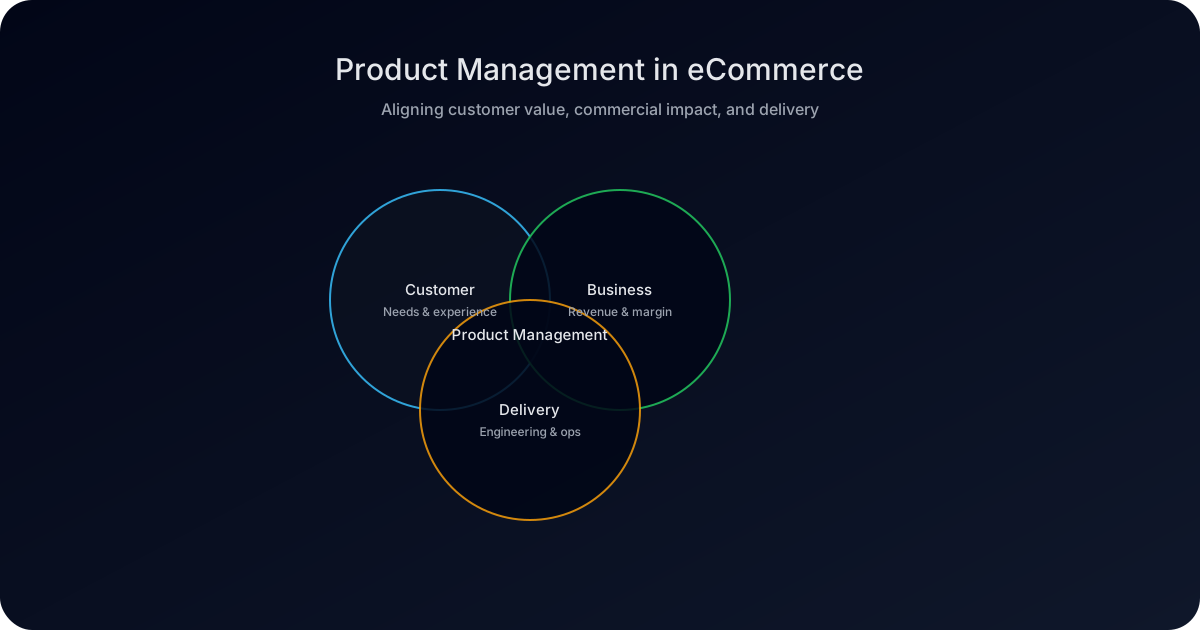
The role of product management in eCommerce
In an eCommerce context, product management is responsible for:
- Understanding customer behaviour, needs, and pain points across the journey
- Translating commercial goals into clear problem statements and opportunities
- Prioritising and sequencing work across product, engineering, and design
- Ensuring what ships is measured, learned from, and iterated—not just launched
Aligning customer and business goals
Good product teams start with clear answers to two questions:
- Who are we serving? Which customer segments and use cases matter most right now?
- What outcomes matter? Are we optimising for conversion, margin, acquisition, retention, or something else?
For eCommerce, that often translates to:
- Reducing friction in discovery, evaluation, checkout, and service
- Improving lifetime value through better repeat experience
- Supporting commercial levers such as categories, campaigns, or new channels
Practical roadmap and prioritisation
A healthy roadmap balances:
- Customer-facing improvements – search, merchandising, checkout, loyalty
- Platform and technical work – performance, reliability, tooling
- Operational needs – internal tools, process automation
Useful patterns include:
- Using simple scoring frameworks (e.g. RICE, ICE) to compare initiatives
- Explicitly allocating capacity to technical debt and platform improvements
- Reviewing and adjusting the roadmap on a regular cadence (monthly or quarterly)
Making cross-functional work real
Slides about “cross-functional squads” are easy; making them work in practice is harder. Key ingredients include:
- A single shared backlog for each team, rather than competing lists per function
- Clear ownership for problem spaces (e.g. search, checkout, seller tools)
- Regular, focused rituals – planning, standups, reviews, retrospectives
Product should articulate the “what and why”; engineering leads the “how”; design ensures the solution is usable and coherent. Commercial and operations bring constraints and opportunities from the frontline.
Measuring what matters
Effective eCommerce product teams are grounded in metrics such as:
- Conversion rate and revenue per visitor (RPV)
- Customer acquisition and retention across key segments
- Operational metrics such as defect rates, customer service contacts, and fulfilment performance
Features should ship with clear hypotheses, instrumentation, and success criteria. Post-launch reviews—what worked, what did not, and why—are where much of the learning happens.
How Rely Tech Serve supports eCommerce product teams
Rely Tech Serve partners with product and technology leaders to:
- Clarify product strategy and priorities across eCommerce journeys
- Design roadmaps and operating models that work for your organisation
- Support teams with discovery, analytics, and delivery practices
If you want to strengthen product management in your eCommerce business, contact us or explore our product and technology consulting services.
FAQs: Product Management in eCommerce
Where should a new product leader focus first?
Start with clarity on goals and constraints—what matters commercially, where customers are struggling, and how teams currently work. From there, you can shape a roadmap and operating model.
How big should eCommerce product teams be?
There is no universal number; what matters is clear ownership of problem spaces and enough capacity to both operate and improve key journeys.
How does this differ for marketplaces vs. single-merchant stores?
Marketplaces add a second set of customers—sellers or partners. Product management must balance buyer and seller needs, which shapes priorities, metrics, and team structure.