Large language models (LLMs) have moved from experiments to production in eCommerce. They now power semantic search, customer support, and internal tooling across retailers and marketplaces of all sizes.
The challenge isn’t whether LLMs can add value—it’s how to integrate them into your existing eCommerce stack without creating operational risk, cost overruns, or architectural sprawl.
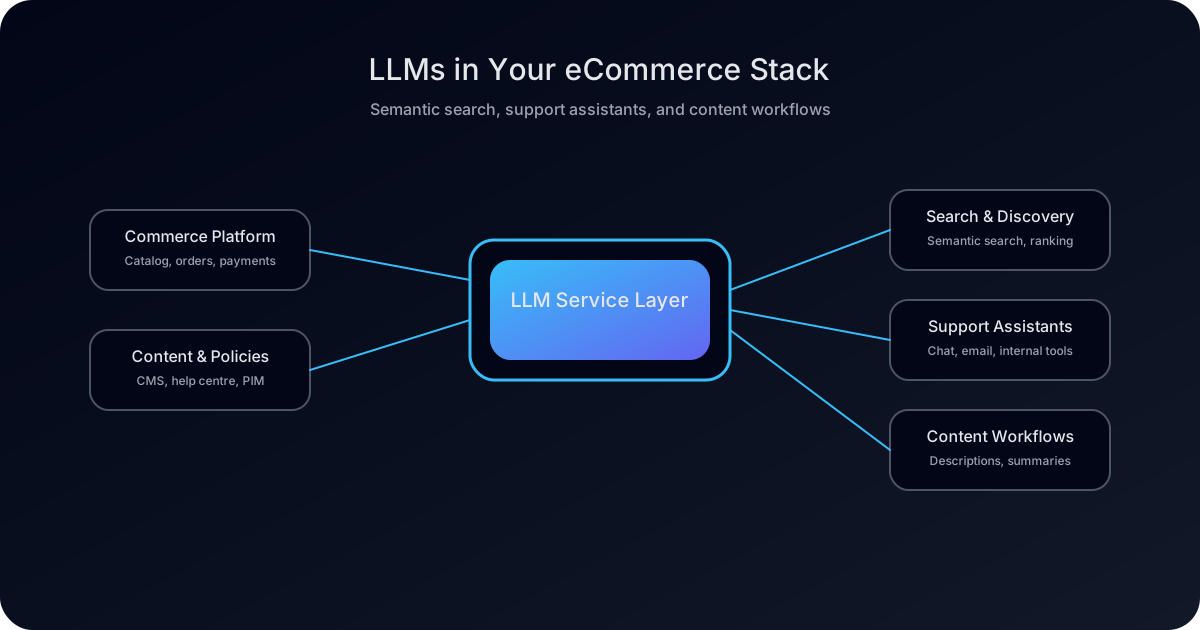
Where LLMs Add Real Value in eCommerce
In practice, we see LLMs delivering the most impact in three areas:
- Search and discovery – understanding natural language queries and intent
- Customer support – resolving repetitive queries and guiding users
- Content workflows – speeding up product and marketing content creation
Semantic search and query understanding
Traditional search engines optimise for keywords. Customers, however, think in tasks and constraints: “waterproof hiking boots for wide feet under £120” or “desk for a small flat that fits dual monitors”.
LLMs and embeddings allow you to:
- Parse natural language queries into structured filters and search terms
- Map queries and products into a shared vector space for semantic matching
- Generate clarifying questions when intent is ambiguous
The most robust pattern is a hybrid search approach: combine your existing keyword or faceted search with vector search, and use ranking logic that considers both.
Customer support and assistance
Support teams are under pressure to do more with the same headcount. LLMs are well-suited to:
- Answering FAQs using your policies, help centre, and order data
- Guiding customers through returns, exchanges, or warranty flows
- Providing product advice where catalog and content are rich enough
The critical design principle is grounding: instead of “letting the model guess”, you retrieve relevant knowledge from your systems (catalog, CMS, policies) and have the model answer strictly from that context.
Content and operations
LLMs can accelerate internal workflows:
- Drafting product descriptions, collection copy, and email variants
- Summarising customer feedback and reviews into actionable themes
- Helping operations teams generate SOPs, training materials, and checklists
The key is to treat LLMs as assistants for your teams, not full automation, especially where correctness and brand voice matter.
Architecture Patterns for LLM Integration
Rather than sprinkling LLM calls everywhere in your codebase, it’s better to define a clear architecture. Common patterns include:
- LLM gateway or service layer that encapsulates prompts, safety rules, and provider integrations
- Retrieval-Augmented Generation (RAG) components for search and support use cases
- Event-driven workers for offline or asynchronous content generation and analysis
This keeps concerns separated: your core commerce platform remains responsible for orders, payments, and catalog; your LLM layer focuses on language understanding, generation, and orchestration.
Governance, Cost, and Risk Considerations
When integrating LLMs into eCommerce, senior leaders tend to worry about three things:
- Safety and accuracy. How do we prevent incorrect or non-compliant responses?
- Data protection. What data leaves our environment and how is it stored?
- Cost control. How do we avoid unpredictable API bills?
Practical steps include:
- Defining allowed data sources and redacting PII before external calls
- Logging all prompts and responses for audit and improvement
- Introducing rate limits, budgets, and caching in your LLM gateway
- Using confidence thresholds and fallbacks (e.g. handoff to human support)
Phased Roadmap for CTOs and Digital Leaders
A pragmatic LLM integration roadmap often looks like:
- Discovery and design. Map use cases, systems, and constraints. Identify where LLMs are likely to add the most value quickly.
- Pilot one or two focused use cases. For example, semantic search enrichment and an internal support assistant.
- Establish an LLM platform layer. Standardise how your teams call models, manage prompts, and measure performance.
- Scale to customer-facing experiences. Once safety and reliability are proven, extend to chat, on-site search, or in-app assistants.
How Rely Tech Serve Supports LLM Integration
Rely Tech Serve works with technology and product leaders to integrate LLMs into eCommerce stacks without compromising security or maintainability. Typical work includes:
- LLM and AI strategy for retail and marketplaces
- Designing semantic search, RAG, and support assistants on top of existing platforms
- Implementing LLM platform layers and governance models
- Running proof-of-concept and pilot programmes tied to clear KPIs
If you are assessing where LLMs should sit in your roadmap, get in touch or explore our AI consulting and digital transformation services.
FAQs: LLM Integration in eCommerce
Do we need to host our own models?
Not necessarily. Many organisations start with managed APIs from providers like OpenAI, Anthropic, or cloud vendors, then consider self-hosting specific models when volume, latency, or data residency requirements justify it.
How do we choose the first LLM use case?
Look for use cases that are high-volume and low-risk, such as internal support tooling or search enrichment, where you can measure value quickly without exposing customers to untested behaviour.
What skills do our teams need?
Product, engineering, and data teams need a shared understanding of LLM capabilities, limitations, and patterns. Rely Tech Serve often supports by pairing with internal teams to accelerate learning while delivering concrete outcomes.