Most retailers have tried chatbots at some point. Many were underwhelmed: rigid decision trees, poor language understanding, and little measurable commercial impact.
Today, conversational commerce looks very different. With modern AI, assistants can understand intent, access real catalog and policy data, and guide users all the way from discovery to checkout—across web, app, and messaging channels.
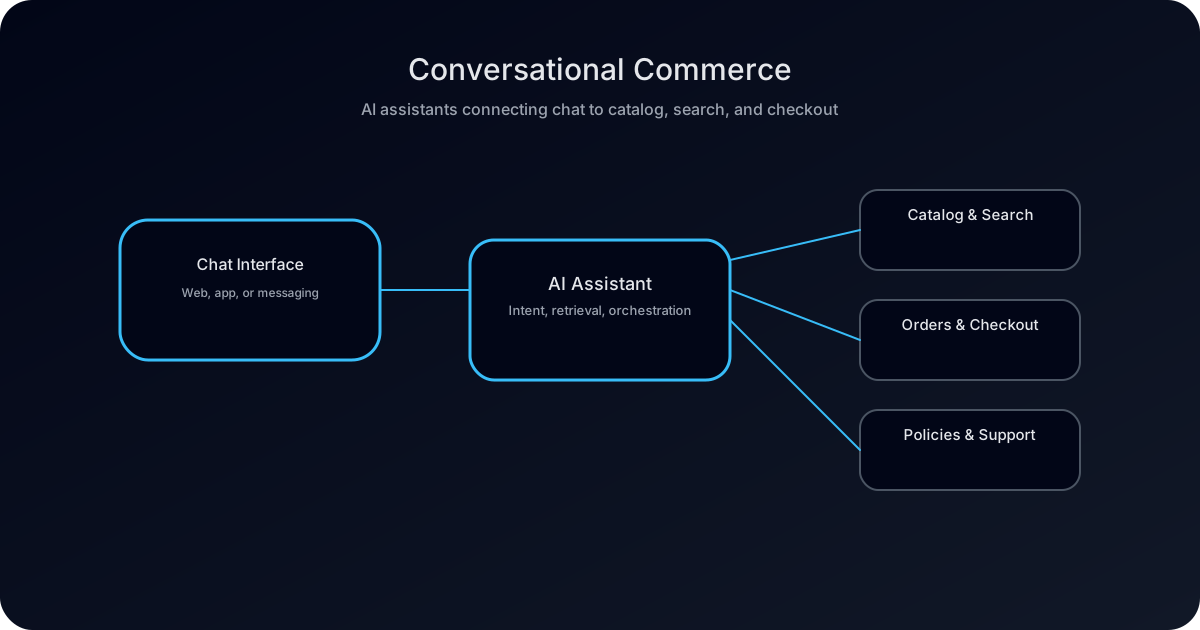
From scripted bots to AI shopping assistants
Early chatbots were essentially interactive FAQs:
- Fixed decision trees and menu options
- Limited or no understanding of free text
- Maintenance overhead every time policies or products changed
They were optimised for call deflection, not experience or revenue.
Modern conversational commerce uses LLMs and retrieval to:
- Understand natural language intent, even when phrased informally
- Retrieve product and policy information from your systems in real time
- Compose multi-step flows that combine advice, comparison, and checkout
Where conversational commerce works best
We see strong results when conversational interfaces are used for:
- Guided discovery – “I need a laptop for video editing under £1,200”
- Assisted configuration – bundles, sizing, compatibility, or subscriptions
- Post-purchase support – order tracking, returns, and exchanges
The pattern is consistent: the assistant reduces friction and decision fatigue, especially in categories with high choice or complexity.
Design principles for retailers
1. Ground everything in your data
Strong conversational experiences are backed by:
- Up-to-date product catalogs and availability
- Clear, machine-readable policies and FAQs
- Pricing, promotions, and shipping data from your existing systems
LLMs should generate language, not facts. Retrieval-augmented generation (RAG) is the default pattern here.
2. Make it part of the journey, not a side-channel
Treat conversational commerce as an integral surface, not a bolt-on widget. That means:
- Entry points from search, category pages, PDPs, and post-purchase flows
- Consistent identity and context across web, app, and messaging
- Clear handoff to humans when needed, with full conversation history
3. Optimise for outcomes, not just deflection
Measure:
- Conversion and AOV for sessions that used the assistant
- First-contact resolution and CSAT for support queries
- Impact on retention and repeat purchase for engaged users
Deflection still matters, but should not come at the cost of customer experience or revenue.
Implementation approach
A pragmatic path looks like:
- Pick one or two focused journeys (e.g. guided discovery in a key category, or returns and exchanges).
- Integrate with core systems (catalog, orders, policies) via APIs and retrieval.
- Launch in a contained channel (e.g. web-only or a single messaging platform), then expand.
- Iterate on prompts, flows, and UI based on real conversation transcripts and metrics.
- Add capabilities gradually rather than trying to solve every use case at once.
How Rely Tech Serve supports conversational commerce
Rely Tech Serve helps retailers and brands move beyond basic chatbots by:
- Identifying high-value conversational journeys across sales and service
- Designing LLM-powered assistants grounded in your systems and data
- Implementing the necessary APIs, retrieval layers, and governance
- Measuring commercial and CX impact, then scaling to additional channels
If you are considering your next-generation conversational commerce strategy, get in touch or review our AI and digital transformation services.
FAQs: Conversational Commerce
Are chatbots still relevant in an LLM world?
Yes, but the underlying technology and expectations have changed. The most effective assistants combine LLM capabilities with clear flows, retrieval from your systems, and human handoff.
Which channels should we prioritise?
Start where your customers already engage—typically your website and app, then extend to messaging platforms where you have a strong presence. Each channel has its own UX constraints and opportunities.
How long does it take to launch a meaningful pilot?
With the right foundations (APIs, access to content, and clear scope), many organisations can launch a focused conversational journey in a few months, then improve it continuously.