On many sites, search is still a weak point: customers either find too much noise or not enough of what they want. In an era where people are used to conversational AI, keyword-only search feels increasingly outdated.
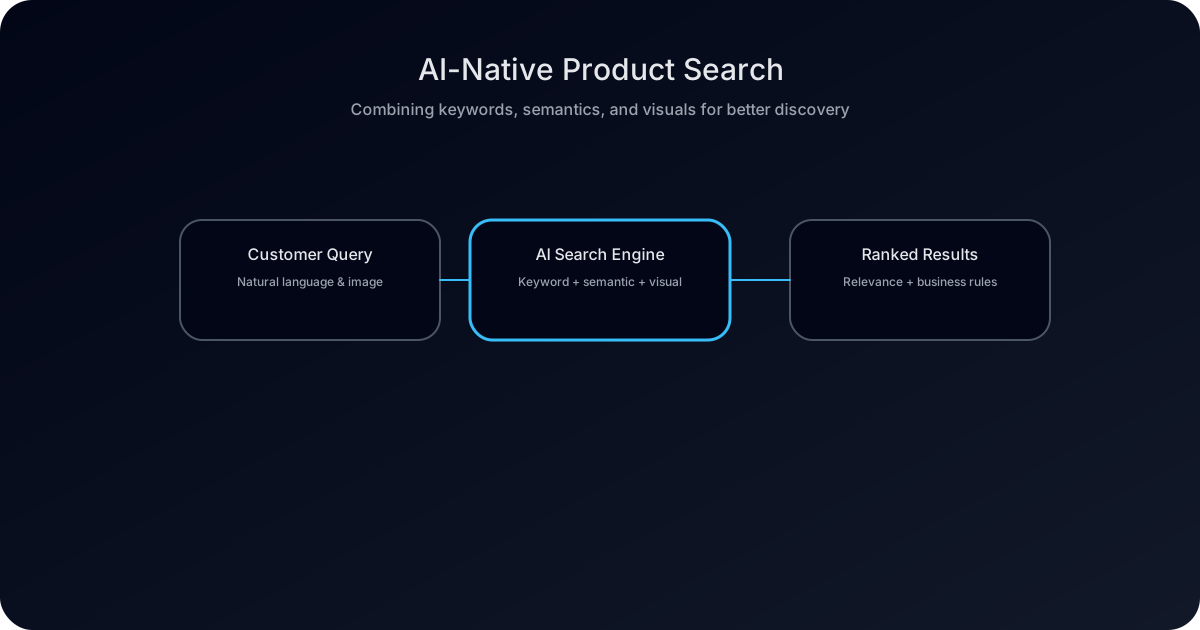
AI-native search combines semantic understanding, natural language queries, and visual search to make product discovery feel more like a conversation and less like a database query.
From keywords to intent
Customers rarely think in terms of exact product names or category labels. They express:
- Goals – “I need a carry-on bag for work trips”
- Constraints – “under £150, fits overhead lockers”
- Preferences – “lightweight, durable, neutral colour”
AI-native search uses embeddings and language models to interpret these signals, mapping them onto your product catalog in a richer way than simple text matching.
Semantic search in practice
Semantic search typically involves:
- Converting product data and queries into vector representations (embeddings)
- Using a vector database or search engine with vector support to find similar items
- Combining semantic scores with business rules and relevance signals (availability, margin, popularity)
This allows you to return relevant results even when the query and product titles use different language.
Natural language queries and assistance
LLMs can further improve search by:
- Parsing long, conversational queries into structured filters and search parameters
- Suggesting clarifying questions when shopping missions are ambiguous
- Summarising and explaining results in plain language
In some cases, you may layer a conversational interface on top of your search, allowing users to refine and narrow results through dialogue.
Visual search
Visual search—letting customers upload or capture an image to find similar products—can be particularly powerful in fashion, home, and lifestyle categories.
Implementations typically:
- Extract visual embeddings from product images and user-uploaded photos
- Use similarity search to find the closest items in your catalog
- Combine with filters (price, availability, size) to refine results
Getting started with AI-native search
A pragmatic approach to modernising search might include:
- Audit current performance – look at zero-result queries, exits from search, and low-engagement terms.
- Add semantic enrichment – use embeddings to improve result relevance for difficult queries.
- Introduce query understanding – use LLMs to rewrite and structure queries before they hit your search engine.
- Experiment with visual or conversational layers in high-impact categories.
How Rely Tech Serve supports AI search
Rely Tech Serve works with eCommerce and marketplace teams to design and implement AI-native search by:
- Assessing current search experience and metrics
- Designing semantic and natural language search architectures
- Integrating vector search and LLM components with your existing search stack
If you want to improve product discovery and search performance, contact us or explore our eCommerce and AI consulting services.
FAQs: AI-Native Search in eCommerce
Do we need to replace our search engine?
Not always. Many organisations start by augmenting their existing search with semantic and LLM layers before considering larger platform changes.
How do we measure success?
Look at search conversion rate, click-through on top results, zero-result rate, and exit rates from search. Over time, track impact on revenue and customer satisfaction.
Is AI-native search only for large retailers?
No. Cloud services and managed platforms have lowered the barrier. The key is to focus on the most valuable journeys and categories first.