Most retailers already show product recommendations somewhere on their site—but the impact varies wildly. In some journeys, they feel distracting or random. In others, they quietly drive a significant share of revenue.
The difference is rarely about UI placement alone. It comes down to how thoughtfully you use AI-powered product recommendations to understand intent, personalise the journey, and optimise for the right commercial outcomes.
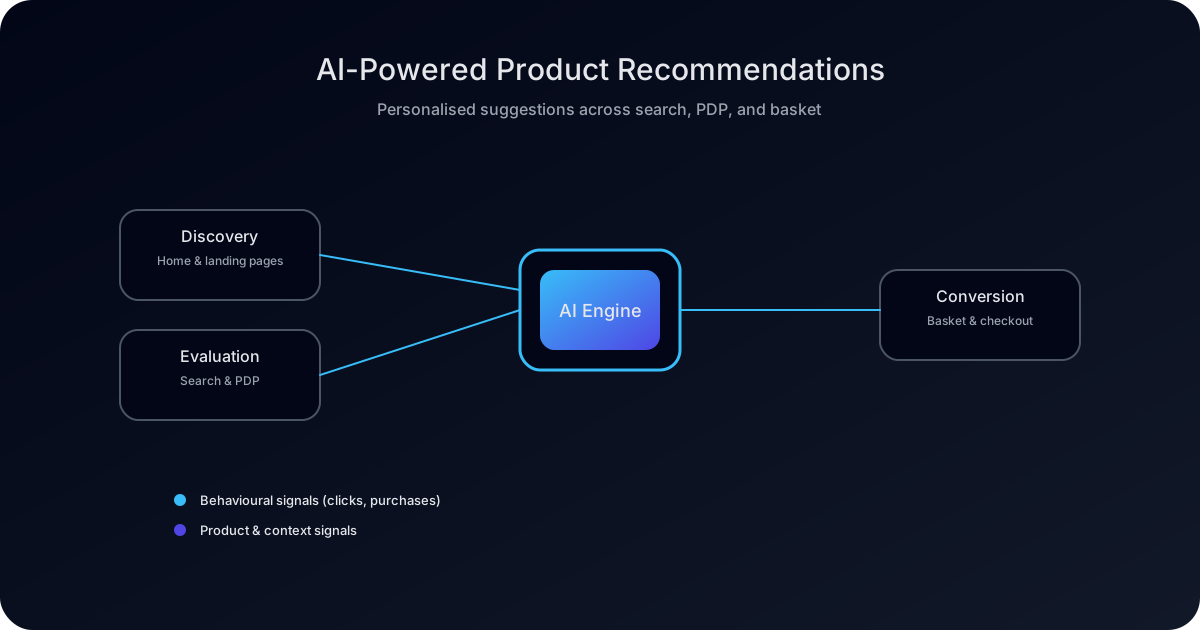
This article walks through a practical approach to AI product recommendations for eCommerce and retail teams who care about conversion, margin, and customer experience, not just click-through rates.
Why AI Product Recommendations Matter
For most B2C and D2C businesses, traffic is expensive. The core question is simple: once a user arrives, how effectively do you turn their attention into revenue and long-term value?
Done well, AI-powered recommendations help you to:
- Increase conversion by surfacing relevant products at the right time
- Grow average order value (AOV) through cross-sell and upsell that feels helpful, not pushy
- Improve retention by reducing the effort required to find what customers need
- Learn faster about what combinations of products and messages actually work
Beyond Basic Collaborative Filtering
Many legacy recommendation engines rely heavily on collaborative filtering: “people who bought X also bought Y”. Useful, but limited.
In practice, high-performing AI recommendation systems combine several signals:
- Behavioural signals – clicks, views, add-to-carts, purchases, returns, wishlists
- Product signals – attributes, category, price band, brand, compatibility, lifecycle
- Context signals – device, time of day, traffic source, campaign, geography
- User signals – history, value segment, preferences where available and consented
Modern AI approaches use embeddings and sequence models to represent these signals in a single space, which makes recommendations more robust to cold start and sparse data problems.
Key AI Techniques That Drive Results
1. Embeddings for products and users
Embeddings map products and users into a vector space where “similar” items are close together. You can train embeddings using historic interactions (clicks, purchases) and product content (titles, descriptions, attributes).
Practical uses include:
- “Similar products” on PDPs that actually reflect style, use case, and budget
- “You might also like” sections that adapt as a customer browses
- Search results re-ranking based on what this user tends to engage with
2. Sequence models for real-time intent
Customers do not browse at random; they follow paths. Sequence models (e.g. RNNs, Transformers) treat each session as a sequence of events and predict the next best action or product to show.
That allows you to:
- Detect when someone is comparing alternatives vs. exploring broadly
- Adjust recommendations mid-session as intent becomes clearer
- Trigger timely nudges (e.g. low stock, bundle suggestions) only when relevant
3. Bandits and experimentation for ranking
Even with strong models, ranking is not static. Multi-armed bandits and related techniques help balance exploring new recommendation strategies and exploiting known winners.
Instead of manually hand-tuning every rule, you can let the system test variants while protecting overall performance.
Designing Recommendation Surfaces Across the Journey
The best AI product recommendations are not one carousel repeated everywhere. They are deliberately designed surfaces that map to the user’s stage in the journey:
- Home and landing pages: personalised entry points (recently viewed, “because you liked…”, editorial collections)
- Category and search: dynamic facets, popularity with similar users, “narrow it down” helpers
- Product detail pages: similar items, bundles, alternatives at different price points
- Basket and checkout: considered cross-sell based on compatibility and margin, not random add-ons
- Post-purchase and CRM: replenishment, complementary categories, and lifecycle-based triggers
A common failure mode is to “turn on recommendations” everywhere without a strategy. Instead, work backwards from clear objectives and design each surface intentionally.
Measuring Impact Beyond CTR
Click-through rate is easy to measure but dangerous as a primary KPI. High CTR on low-intent products can cannibalise more important actions.
Stronger measurement patterns include:
- Incremental revenue per session with and without specific recommendation modules
- Add-to-cart rate and conversion rate for sessions where recommendations were visible vs. hidden
- Impact on margin – are you pushing profitable items, not just discounted stock?
- Long-term effects on retention and repeat purchase across segments
Where possible, run A/B tests that isolate recommendation changes from other marketing or UX updates.
Common Pitfalls to Avoid
- Over-personalisation too early. If you overfit to thin data, you can trap new users in narrow bubbles.
- Ignoring business constraints. Your models should respect stock, margin, contractual obligations, and compliance rules.
- “Set and forget” deployments. Models, catalogues, and customer behaviour all change; governance and retraining are crucial.
How Rely Tech Serve Can Help
Rely Tech Serve works with eCommerce and retail teams to design and implement AI-powered product recommendation systems that actually convert, not just impress in demos. Typical engagements include:
- Assessing your current recommendation stack, data, and constraints
- Designing journey-specific recommendation surfaces tied to commercial goals
- Implementing embeddings, sequence models, and ranking logic in a way that fits your architecture
- Building an experimentation and measurement framework that your teams can run with
If you are considering a new recommendation engine or want to get more value from your current setup, get in touch or explore our AI and data consulting services.
FAQs: AI Product Recommendations
What are AI-powered product recommendations?
AI-powered product recommendations use machine learning models to predict which products are most relevant to a specific user in a specific context, rather than relying only on simple rules or static “popular items” lists.
How long does it take to see impact?
Many retailers see measurable uplift from well-designed recommendation pilots within a few weeks of going live, especially on high-traffic surfaces like PDPs and basket pages. Larger gains come as you iterate on models and surfaces based on data.
Do we need a full data science team to do this?
No. Off-the-shelf platforms can be effective when combined with good product thinking and clean data. Where you do want to differentiate deeply, in-house or partner data science becomes more valuable. Rely Tech Serve often works as an extension of your internal teams in this space.