Most digital leaders can feel the shift already: customers are spending more time inside AI assistants and less time browsing traditional websites. At the same time, your commerce stack is still optimised for people clicking through pages, not for software agents acting on their behalf.
That is the core idea behind agentic commerce—a world where AI shopping agents understand intent, evaluate options across multiple merchants, and complete purchases end-to-end. For retailers, marketplaces, and brands, this introduces both new risk and new opportunity.
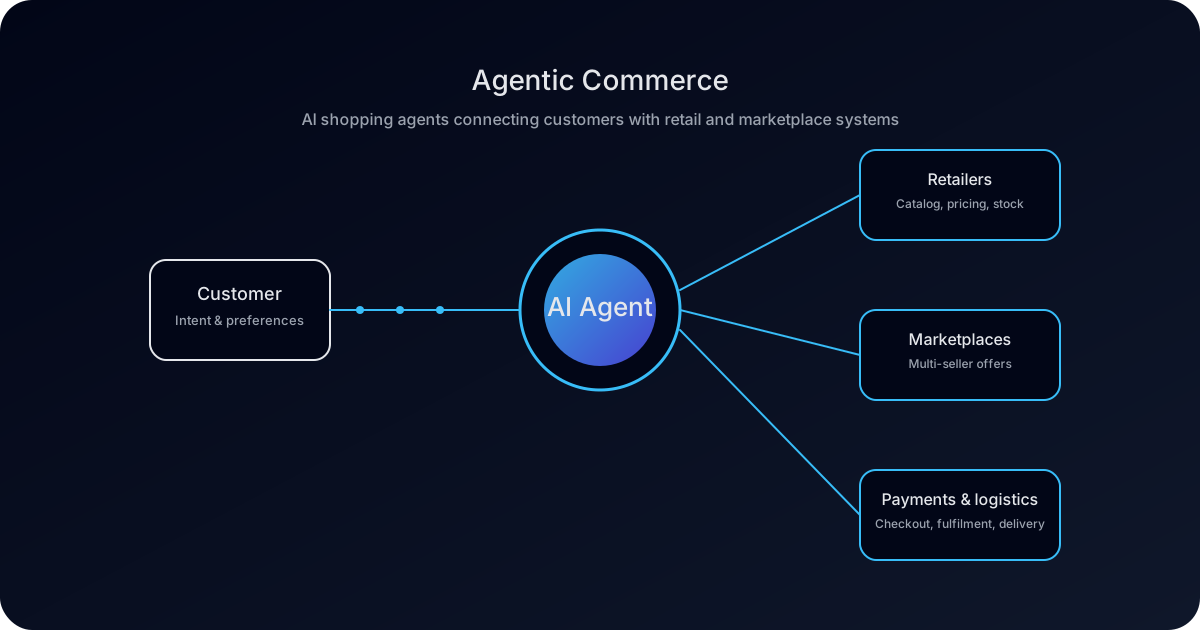
This article explains what agentic commerce is, how AI shopping agents change the customer journey, and the practical steps you can take in the next 6–12 months to make your organisation ready.
Table of Contents
- What Is Agentic Commerce?
- How AI Shopping Agents Change the Customer Journey
- Implications for Merchants and Marketplaces
- Data, APIs, and Architecture for Agentic Commerce
- Checkout, Payments, and Emerging Standards
- Security, Risk, and Governance
- How to Get Started in 6–12 Months
- FAQs on Agentic Commerce and AI Shopping Agents
What Is Agentic Commerce?
Agentic commerce is a model where AI agents, not humans, drive the shopping journey. A customer expresses an outcome in natural language—“find a birthday gift for my mum who loves gardening, budget £50, delivered by Friday”—and a shopping agent handles the rest:
- Interprets the user’s intent, constraints, and preferences
- Searches across multiple merchants or marketplaces
- Compares price, delivery, reviews, and policies
- Selects a recommended option (or short list)
- Builds the basket and completes checkout within agreed limits
Instead of optimising only for human visitors who click and scroll, you now need to optimise for software agents that consume structured data and APIs, and that are judged on how effectively they fulfil customer intent.
How AI Shopping Agents Change the Customer Journey
Today’s eCommerce journeys are still measured in sessions, page views, and funnels. In an agentic world, the key metric becomes intent fulfilment—did the agent successfully find and purchase the right product for the user’s goal?
That changes several assumptions:
- Less direct traffic, more mediated demand. Customers may never visit your website directly; their agent engages your systems via APIs or feeds.
- Compressed funnels. Discovery, evaluation, and purchase can happen in a single conversational flow. You need high-quality product and offer data from day one.
- Context-rich decisions. Agents use preference history, constraints, and budgets far more consistently than a typical human session.
For digital leaders, the strategic question becomes: how do we make our products easy for AI agents to find, understand, and transact with?
Implications for Merchants and Marketplaces
Agentic commerce has concrete implications for how you operate.
1. You must optimise for AI discovery, not just human SEO
Answer Engine Optimisation (AEO) is not just about featured snippets. AI shopping agents will:
- Prefer merchants with clean, consistent product attributes rather than free-text descriptions only
- Rely on up-to-date price, stock, and delivery data to make decisions
- Downgrade sources that regularly produce errors, out-of-stock items, or policy surprises
This makes your PIM, catalog, and offer data quality a genuine competitive advantage. If an agent cannot reliably compare your offers to others, you simply will not appear in its short list.
2. Brand still matters—but the relationship shifts
For high-consideration categories, customers will still ask explicitly for brands they trust. But for replenishment or low-consideration purchases, they may only specify an outcome and constraints. In those cases, the agent effectively becomes the new “shelf” or “search results page”.
To remain relevant you need both:
- A clear brand position—so customers name you as a preference when they care
- Operational excellence—reliable delivery, low return rates, strong ratings—that agents can easily quantify
Data, APIs, and Architecture for Agentic Commerce
Most organisations already have the right data somewhere; it is just fragmented across eCommerce, PIM, ERP, WMS, and custom tools. Agentic commerce forces you to bring that together.
At a minimum, AI shopping agents will expect access to:
- Product data – titles, descriptions, attributes, images, relationships, compatibility
- Offer data – prices, discounts, availability by region and channel, delivery promises
- Merchant data – ratings, policies, certifications, trust and safety signals
- Operational constraints – cut-off times, perishability, export restrictions, age limits
From an integration perspective, that usually means building or improving:
- Read APIs for catalog, offers, and inventory
- Cart and order APIs that can be safely invoked by delegated agents
- Webhooks or event streams for order status, stock changes, and cancellations
Rely Tech Serve typically helps clients map their current architecture, identify gaps, and design a progressive API roadmap so you can support agentic commerce without disrupting existing channels.
Checkout, Payments, and Emerging Standards
Most checkout flows still assume a human at a browser: CAPTCHAs, one-time codes, modal dialogues, and device-bound wallets. AI agents break those assumptions.
To support agent-initiated purchases safely, you will need:
- Tokenised payment methods that can be used with explicit limits (value, frequency, category)
- Delegated consent flows where the user approves an agent to buy on their behalf under defined conditions
- Machine-readable policies for SCA, risk checks, restricted items, and geographic rules
Emerging approaches such as the Universal Commerce Protocol (UCP) aim to standardise how agents and merchant systems describe products, offers, and transactions. You do not need to commit to any one standard today, but you should design your internal APIs so that they can be mapped cleanly onto whichever protocols win.
Security, Risk, and Governance
Agentic commerce extends your attack surface. New risks include:
- Prompt injection and agent manipulation via untrusted content such as reviews, messages, or third-party data
- Over-permissioned agents that can modify orders, issue refunds, or view sensitive data without sufficient controls
- Unintended data sharing if sensitive catalog or pricing information is exposed to external models without guardrails
Good governance for AI shopping agents typically includes:
- Clear scopes and permissions for what agents can and cannot do
- Monitoring and audit logs for every agent-initiated action
- Separation of duties between read, simulate, and execute capabilities
- Well-defined fallback to humans for high-value or high-risk scenarios
How to Get Started in 6–12 Months
You do not need a multi-year transformation programme to start. A pragmatic roadmap for most retailers and marketplaces looks like this:
- Assess readiness. Audit product, offer, and policy data. Review existing APIs for catalog, search, and orders. Identify quick wins and high-risk gaps.
- Improve data quality. Enrich key attributes, standardise taxonomies, and ensure critical fields (price, stock, delivery) are accurate and timely.
- Harden and extend APIs. Expose catalog and order capabilities with clear contracts, authentication, and rate limiting suitable for agents.
- Pilot a controlled use case. For example, a replenishment assistant for existing customers, or a gifting use case within a trusted channel.
- Measure and iterate. Track intent fulfilment rate, conversion, margin impact, and operational load. Use the results to inform expansion.
Rely Tech Serve works with leadership, product, and engineering teams to structure this into a realistic plan that aligns with your broader digital transformation roadmap.
FAQs: Agentic Commerce and AI Shopping Agents
What is agentic commerce?
Agentic commerce is a model where AI shopping agents, rather than humans, handle product discovery, evaluation, and checkout. Customers express goals in natural language, and agents complete the purchase within defined permissions and budgets.
Do we need a new eCommerce platform to support this?
In most cases, no. You can start by improving data quality, exposing or hardening APIs, and introducing agent-specific consent and security layers on top of your existing platform.
Which categories are best suited to agentic commerce?
Early success tends to come from categories with clear attributes and repeat behaviour—groceries, household items, office supplies, and standardised electronics—though high-consideration purchases will also be impacted over time.
How should we measure success?
Focus on intent fulfilment rate, conversion and margin from agent-initiated orders, and error or failure rates across APIs and data. Over time, compare lifetime value and satisfaction for customers who adopt agentic journeys versus traditional ones.
Working with Rely Tech Serve
If your organisation is exploring agentic commerce or AI shopping agents, Rely Tech Serve can help you:
- Design an agent-ready data and API strategy for your catalog and offers
- Implement secure, consent-driven checkout and payment flows suitable for agents
- Embed governance, monitoring, and controls around AI-driven automation in your commerce stack
If you would like to discuss pilots, architecture options, or a 6–12 month roadmap, get in touch or explore our AI consulting and digital transformation services.